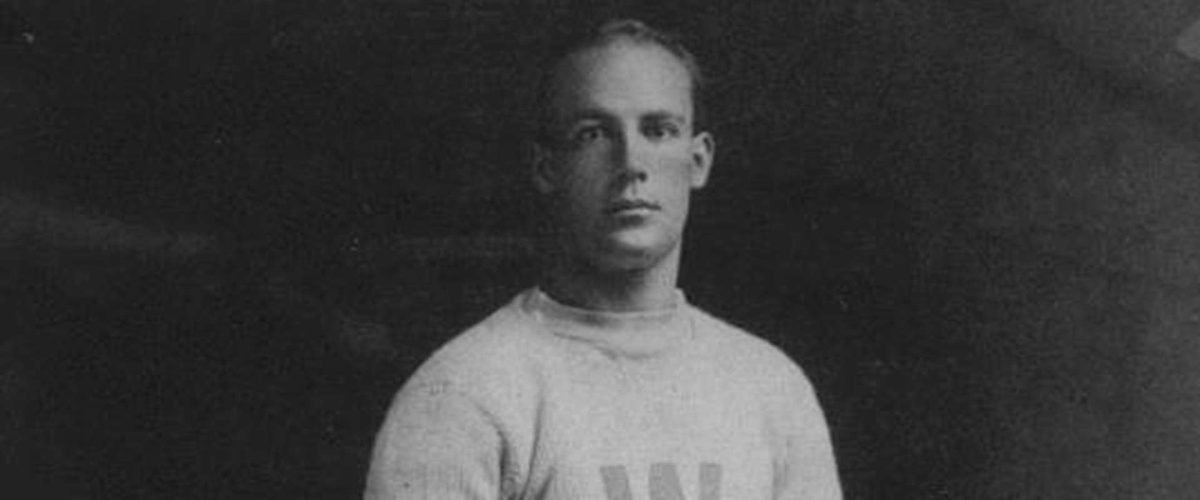
Benjamin Lee Boynton was a legend in the early rough and tumble days of professional football. His credits include the National Football Foundation’s College Football Hall of Fame and the Texas Sports Hall of Fame. And yet Boynton’s accomplishments after his career in football in his hometown are nearly as impressive.
Ben Lee (sometimes “Benny”) was born in Waco on December 6, 1898, to Charles and Laura Boynton. He begins appearing regularly in various Waco newspapers as early as 1913 as a star athlete on various sports teams sponsored by the Young Men’s Christian Association (YMCA). He also makes numerous appearances as a singer, whether as a soloist at St. Paul’s Episcopal Church or singing at the YMCA Father and Son Banquet.
But it is with his entry into Waco High School as a ninth grader that Boynton really begins to shine. While he lettered in every varsity sport during his time at Waco High, it was as a football player that he drew the most attention. Boynton had the benefit of playing for the legendary Paul Tyson, who transformed Waco High School into the dominant football program in Texas in the 1920s, amassing an astonishing 80 wins, two losses and two ties between 1921 to 1927, along with several state championships.
Boynton’s speed, strength, kicking prowess and passing accuracy in an era that rarely employed the forward pass quickly drew the attention of a host of colleges. In his oral history for Baylor University, Wacoan Robert Lee Lockwood recalled his amazement in seeing Boynton throw a football the length of the field.
Boynton was the quarterback when Waco High played Fort Worth Northside in fall 1915 for the mythical state championship in the state’s last pre-University Interscholastic League title game. The game ended in a 6-6 tie.
Waco High’s yearbook, The 1916 Daisy Chain, features several photographs of Boynton, including a portrait of the young, handsome Ben Lee as class president.
How and why Boynton chose to attend Williams College in rural Massachusetts remains a mystery. Though East Coast and Midwest college football dominated the newspapers, the Williams College Ephs (pronounced like “chiefs” — named in honor of their founder the Rev. Ephraim Williams) was not a national powerhouse. Until Boynton’s arrival.
Once enrolled at Williams, Boynton’s football prowess generated front page coverage in the national press for the Ephs, including an undefeated season in 1917, highlighted by a 9-6 victory over a powerhouse Columbia team. He also earned All-American honors in football.
But in early 1918, Boynton, like many of his classmates, enlisted in the military in what would have been his sophomore season. He served as a gunnery sergeant in the Marines at the tail end of World War I but mustered out before classes began in September 1919. His return to Williams even merited an article in the New York Times, which noted he was accompanied by his brother Charles, a freshman, who was expected to play football as well.
Back at Williams College, Boynton’s collegiate career quickly resumed with the same devastating effect. Boynton soon earned the nickname “The Purple Streak” during those years and again became an All-American in 1919 and 1920, seasons that included wins over Harvard, Princeton and Yale. For years, the 40-yard drop kick field goal he executed in 1919 against Williams’ bitterest rival, Amherst College, remained the longest such kick in the college football record books.
One of the many highlights of Boynton’s years as a two-way player (and kicker) for the Ephs was his record-setting 110-yard run back of a failed field goal kick against Hamilton College in 1920. His senior year, he led the nation in scoring.
Years later, Boynton — who throughout his life remained modest about his accomplishments — told The Dallas Morning News, “He kicked it right to me. The scrimmage line was all the way across the field, so about all I had to do was run.”
After graduation, Boynton worked for Bethlehem Steel, joined the American Professional Football Association’s Rochester Jeffersons in 1921 and was selected All-Pro. The league rebranded as the “National Football League” in 1922. In 1924, he played for both the Buffalo Bisons and the Washington Senators and was selected to the league’s All-Pro first team yet again.
Professional football was much more casual in those days. Boynton even played for two different teams on the weekends — the Frankfort Yellow Jackets on Saturdays and the Buffalo All-Americans on Sundays.
Boynton still found time to marry Katherine Darby on October 27, 1922.
But Boynton left professional football at the end of the 1924 season and for several years turned down opportunities to coach football, including Baylor University.
After initially considering enrolling in West Point, he joined the H.W. Marshall Insurance Company and returned to Waco in 1926. Boynton eventually became president of the highly successful Loyalty Group Insurances Companies.
He also became involved with some of the earliest sports reporting and commentary on the radio in Texas, quickly becoming a popular announcer for some of the first Southwest Conference football broadcasts.
When a national collegiate radio broadcast, the popular Coca Cola College Night program on the Texas Quality Network, was scheduled for Baylor University in April 1925, Boynton was chosen as host. Boynton introduced the Golden Wave Band for several musical numbers, Baylor yell leaders, led by Ramsey Yelvington (who would become a nationally known playwright) performed, and the student body packed the new Waco Hall for the show.
Boynton also busied himself in becoming a football referee and systematically began building the Southwest Football Officials Association and served as its first president. By 1928, The Lariat called him “one of the best officials in the Southwest.”
During his 14-year career as a football official, he refereed at both the second Sugar Bowl game on January 1, 1936, and the first Cotton Bowl Classic (then called the “Dixie Classic”) on January 1, 1937.
If that’s not enough, Boynton, an avid amateur golfer, was also instrumental in the founding of the Texas Golf Association, which governed amateur golf in the state, and served as the organization’s long-time president.
Boynton finally retired from the rigors of officiating in 1939. But when the United States went to war again in 1941, he enlisted as a lieutenant commander in the U.S. Navy Reserve.
After the war, Boynton returned again to Waco. Unfortunately, within a few years, his health began deteriorating. When he was elected to the Collegiate Football Foundation’s Hall of Fame in 1962, he was too ill with cancer to attend the awards dinner in New York City. The organization sent a representative to Boynton’s bedside to present the award.
Boynton died in Dallas on January 23, 1963, and was cremated and interred in Restland Memorial Park in Dallas. He was survived by his wife Katherine and his brother, Charles. Ben Lee and Katherine had no children.
He was elected posthumously to the Texas Sports Hall of Fame in 1965.
Boynton’s death was a major news story through several newspaper cycles, and football legends past and present wrote movingly of Boynton, both as a person and an athlete.
One of the best tributes came from Houston Chronicle Sports Editor Dick Peebles. Peebles wrote of a bitterly fought high school playoff game that Boynton officiated between Abilene and Cleburne in 1928. When Boynton — correctly — over-ruled an earlier call that negated a Cleburne touchdown, Abilene pulled ahead and won the game.
Cleburne fans were irate. And Boynton, who had recently established an insurance firm in Cleburne with another partner, felt the brunt of it — a host of his policies were immediately cancelled.
“The decision was a tribute to the courage and integrity of Ben Lee Boynton,” Peebles wrote shortly after Boynton’s passing. “He did what he thought was right in the football game, regardless of the consequences.”