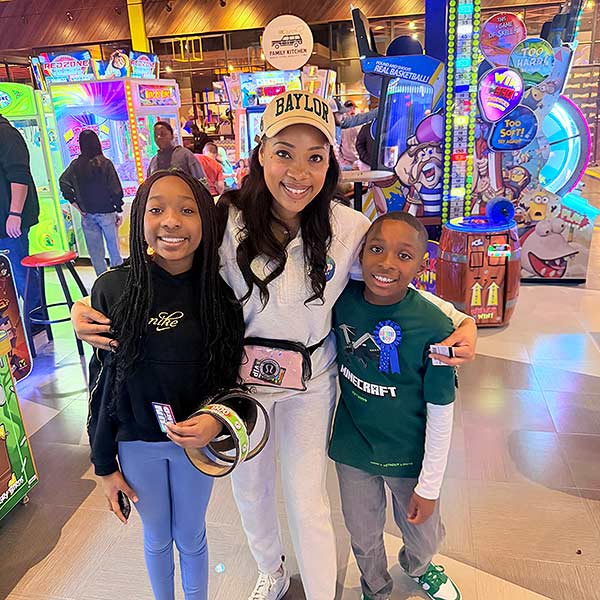
In a life shaped by cross-country moves, demanding jobs and a growing family, Shamira Chaney is calm, centered and optimistic. Chaney and her husband, former NFL linebacker and Baylor University linebacker coach Jamar Chaney, have four beautiful children — Rhaelyn, 12; Eli, 10; Leo, 5; and Teo, 3. Three of them are on the autism spectrum — a reality that has not only shaped her perspective, but inspired her to share her journey and how she’s learned to create stability, purpose and joy in the midst of constant change.


Your family has moved frequently because of your husband’s coaching career. How have you managed to stay grounded through so much change and so many challenges?
We always say our home is us. A house is just four walls. We can make any house a home as long as we’re together. That’s something we decided early on in our marriage. Some coaching families do long distance, and that works for them, but that was one thing we said we wouldn’t do. If it breaks us apart in any way, even distance, then it’s not for us. We know that God wants our family together, and that’s how we thrive.
When did you first start noticing that something might be different with your oldest son?
With Eli, I started noticing little things pretty early, but at the time, I didn’t have the language for it. I just knew something felt off. He would line objects up, and it wasn’t just like a toddler playing. It was very specific. And if you moved even one thing a quarter of a centimeter, he noticed. That would trigger a meltdown that could last 30 or 40 minutes.
He also wasn’t really talking. Or if he did, it wasn’t functional. It wasn’t communication. So I brought it up to our pediatrician, and I was dismissed. They said he was young, that boys develop slower, that his sister probably talked for him. I trusted that at first, but something in me kept saying, ‘No, there’s more to this.’
I went back again, and then a third time, and each time it was brushed off. After that third visit, I told my husband, ‘We need a new pediatrician.’ The very first visit with the new doctor, she said, ‘You have every right to be concerned.’ That was the first time I felt heard. From there, we saw a neurologist, and within 30 minutes, he said, ‘He absolutely is on the autism spectrum.’
What was that moment like for you — hearing the diagnosis?
It was a mix of emotions because I knew absolutely nothing about autism, other than the word, and I did not know what it meant. You don’t know what the future looks like. So in that sense, it was scary, but it was also a relief. I had been questioning myself because I had been dismissed so many times. Now I finally knew for sure that I am not crazy, that there was something different. I thought maybe I was reading too much into it, but the diagnosis told me I wasn’t wrong in picking up on certain things.
Before that, when he would have those long meltdowns, I didn’t know what he needed. I would just hold him and hug him through it, and then afterward I’d go sit in the closet and have a meltdown myself because I didn’t know what he needed. Once we had the diagnosis, it gave me hope that I could meet my child where he is and get him some help.
What did moving forward look like in those early days?
It was immediate. We didn’t wait. We got him into everything we could. ABA [Applied Behavior Analysis] therapy, speech therapy, occupational therapy — we used state programs, private services, anything that was available to us.
It was a lot. It was a full schedule, and it was overwhelming at times, but I never questioned it because I could see that it was helping him. He started making progress. He started communicating more. Through therapy, he started using language in a meaningful way. Seeing those little steps forward gave me so much hope. It made all the appointments and all the driving worth it.
How did that experience shape you as a parent?
It changed everything. Every child is different. Every child is going to come up with their own set of challenges. What works for one child doesn’t necessarily work for another, and I had to let go of that idea that there’s one right way to do things. I had to learn how to meet him where he was instead of trying to bring him into what I thought things should look like. And I had to advocate. You have to speak up. You have to ask questions. You have to push when something doesn’t feel right. That experience made me more confident in my instincts as a mom.
You now have three children on the autism spectrum. How did your experience with Eli prepare you for that?
I always say, thank God for Eli. God gave me Eli first because now I have a roadmap. With my second son, I knew at 2 months old. He avoided eye contact completely. It was like it scared him. And because I had already learned so much, I recognized it right away. We were able to start intervention so much earlier because of that.
And then with my youngest, I noticed signs around 9 months. Again, we were able to act quickly. Every child is different but having that knowledge made such a difference. It took away some of the fear because I knew what steps to take.
Did you ever hesitate about growing your family after that first diagnosis?
No, we didn’t. We’ve always loved kids and knew we wanted a big family. Doctors will tell you there’s about a 50/50 chance, but for us it was like — we know what to do now. We have a blueprint.
But you have to let go of expectations in order to fully and wholly love this child that’s in front of you — to help them reach their fullest potential. My husband’s a football coach; he wanted football players. Eli [couldn’t] care less about football. He likes basketball and soccer. He’s getting the younger ones started a little earlier running around with the football, so we might get one after all. But you have to get rid of those expectations.

How did Waco do, in terms of meeting your children’s needs?
Waco has just been such an inclusive community. We are so blessed and so fortunate to be here. I feel like God really set it up perfectly, for us to land in a community like Waco. The schools have been so inclusive. Our kids are at South Bosque and it has been the best experience that we’ve ever had with schools — and we’ve lived in a lot of states and had a lot of experiences with different schools — the interventions, the support, the different resources we’ve been able to tap into, I have seen my boys thrive. When we first moved here, my now 5-year-old, who was 3-and-a-half at the time, was not talking. Now he is talking. Eli is in general education at South Bosque. It’s been a great place.
We’ve really been able to see the development just take off and it’s a team effort. It’s the schools we have them plugged into, the services we’re getting. I’m in and out of my car 60-plus times a week, making sure the kids have and get everything they need — occupational therapy, speech therapy, behavior therapy and then, of course, the extracurriculars. I look at it all and I’m like, ‘It’s not a burden. I get to do this. I enjoy doing it.’ My kids are thriving because of it all.
What does your day-to-day life look like now with four kids?
It’s busy. There’s no way around that. Between school drop-offs, therapies, appointments, activities — it’s constant. There are days where it feels like we’re just moving from one thing to the next, but I try to stay grounded in the purpose behind it. I get to do this. I get to help my kids grow and develop and thrive. So when I think about the driving and the scheduling, it puts it into perspective.
Tell me about Rhaelyn, your first-born and only daughter.
Rhaelyn — I always say God knew we needed her first. She is the sweetest, most empathetic and most creative and remarkable girl. She is quite the artist and has been gifted at drawing since she was in kindergarten. From the very beginning with her first brother, she’s always been so protective, so sensitive and aware of his differences, but also so understanding of them. Same with her two younger brothers.
With such a full home life, do you two girls get much time to yourselves?
Yes. I’m very intentional about crafting time with my kids collectively and individually. One of our favorite things to do during mother-daughter time is play Roblox together. Our favorite game is Dress To Impress where you’re given a theme and six minutes to come up with full hair, makeup, outfit and accessories to fit the theme. After the time is up you walk the runway and vote on everyone’s ensemble.
When we go out for mother daughter time our go-to is Starbucks. She loves the matcha Frappuccinos. I just love that one-on-one time and getting to hear about all of the things going on in her world, away from the house.
I’m sure she’s got plenty going on, at her age.
We’re big on encouraging her to get involved in extracurricular activities and have had the pleasure of watching perform on stage with the Waco Children’s Theatre. She’s also performed with dance and choir at her school. She’s typically a shy girl, so seeing her come out of her shell since moving to Waco and performing on stage has truly been amazing. It’s been important to me to encourage her individuality and interests with our very busy and sometimes very demanding life and schedules. I always want her to know that she’s a priority and her interests and passions are important. So I’ll continue doing all I can on my end to cultivate that.
How do you balance all of that without burning out?
I definitely believe in prioritizing peace. What that looks like is going to be different for everyone, but I believe in ‘pockets of peace’ in my day. I am not a big morning person. I’m not the mom that’s waking up at 5 a.m. just so I can have time to myself. At least not yet. Maybe in the future that is me. But right now, my husband gets the kids up in the morning so I can start my mornings slower. He knows that I value a slower morning, so that’s a pocket of peace for me. Once the kids are dropped off to their places — we have one at River Valley [Middle School], two at South Bosque, and one goes to therapy — I get a couple hours to myself.
At home, I can enjoy the silence, make a cup of coffee, make myself some breakfast. I’m big into worship music, so in my car we only listen to Christian radio so after I do all my drop-offs, I get my worship time in, even in the commute. That’s a pocket of peace in my day. I love the different coffee shops — lately, Be Kind Coffee. You can find me there once or twice a week, just making sure I take a few moments to myself. Those pockets of peace throughout the day are very helpful for me.
Is there anything about you that people might not notice from your positive outlook and ability to get things done?
Yes. I have POTS (Postural Orthostatic Tachycardia Syndrome) and have for over 20 years. But I only just got diagnosed last year after decades of misdiagnosis and mystery.
A lot of people think it’s crazy when they find out that I have POTS, given all I balance on a day-to-day basis.
What have you learned about your children through this journey?
That they are all so different, even within the same diagnosis. Autism is not one-size-fits-all. Each of my boys has their own personality, their own strengths, their own challenges. I’ve also learned how resilient they are. The things they work through, the progress they make — it’s incredible to watch. It’s taught me to celebrate things that other people might overlook. Milestones look different for us, but they’re just as meaningful.
How has this experience impacted your marriage?
Jamar is a great support. Even with his schedule — because it is a lot, sometimes 80 or 90 hours a week — my husband is very intentional about being present when he is home. He’s hands-on. He’ll tell me, ‘Babe, go to bed. I’ll do the dishes when I get home.’ Every Sunday, he does all the laundry. That’s his thing. So even though his job is demanding, I don’t feel like I’m doing this alone. It’s not like I’m carrying everything by myself. We’ve found a rhythm where we’re supporting each other, and that’s what allows everything else to work.
It’s a nice balance having a supportive, God-fearing partner. He’s up every morning an hour before he even has to be, just reading his Bible, praying. He prays over our family, over our children, over our marriage. Sometimes, from the outside looking in, people wonder how we’re doing it. Honestly, it has to be God’s grace.
So your faith plays a big role in how you navigate all of this.
My faith has been the thing that has saved me. Through everything, I’ve always, I guess, kind of erred on the side of optimism. That’s always been a faith thing for me, just knowing that if God brings you to it, He’ll bring you through it. So the glass is always going to be half full for me. I don’t shy away from that anymore. Growing up, I was different, always erring on the side of optimism, always erring on the side of hope. Later in life, I learned that was the Holy Spirit. So that has been the thing that just keeps me going, empowering and encouraging me. Without my belief system, I don’t think things would flow.
With everything you have going on, do you have time to cook?
Yes! That is definitely something I’m known for. I love to cook. I grew up in a big family, I have six sisters and a brother, and my mom made sure she taught all of us to cook at young ages. I remember being in middle school and preparing dinner for the whole family. At 19, I cooked my first full Thanksgiving meal while visiting my then boyfriend — now husband — at college. He bragged to his roommates about what a great cook I was and somehow talked me into making an entire Thanksgiving spread. I’m pretty sure that day was the one he decided we’d get married.
Now cooking has turned into a passion that I use for my family, as well as our players. We had solo dinners with all of my husband’s linebackers every Monday and Wednesday in February and March. A few times a year we’ll have them all over and they all vote for a home cooked meal. During the season, my kids and I bake every Thursday for ‘sweet Fridays’ for the linebackers. Cooking is my expressive love language.
As if you’re not busy enough, you have a blog called ‘Unfiltered Womanhood’ where you write about family, faith and food — and you’re working on your master’s degree. What inspired you to go back to school?
I’ll be finished with my master’s in family counseling in December. I specifically want to work with families with special needs kiddos and individuals because I know that there is a need for it. I’ve been in the role of helping other families navigate having a child with autism or suspecting they do. Early intervention is key. So it just kind of became my role to not only advocate for my kiddos, but to advocate for these other kiddos where the families don’t want to hear that diagnosis.
What do you wish more people knew about autism — that you hope to show them?
That it’s not a death sentence. Autism is not terminal. The diagnosis is what you need for insurance to kick in and to get your child services. So just kind of taking away the stigma of it all — speaking about it in such a way where there’s no shame in it. You didn’t do anything wrong and early intervention can really mean everything for your child.
And so when I found myself having these conversations more and more and seeing more of a psychological side, and wondered, ‘Do they have therapy for this?’ That’s why I decided to go back to school to get the degree in family therapy.
For people out there who maybe don’t have your energy or ability to find resources, where would you tell them to start?
Here in Texas, there is the Department of Health and Human Services where there are free resources available. If you don’t meet a certain income threshold, there are Medicaid services available where these kiddos can receive ABA therapy, speech therapy, occupational therapy — all covered under these state-funded services. They are accessible for everyone, but you have to make the call. If you have school-aged children, there are psychologists within the school district that you can reach out to get a child evaluated to see what services they could be offered through school. Then there are local organizations and charities, like the Autism Network and I’m actually going to be volunteering at their event in a couple weeks. There are also some support groups; Facebook is a great place to find those. There is a whole community of us autism parents ready to share information and resources. I want them to know they are not alone.
And for those reading who don’t have kiddos with autism, but maybe you know someone who does, check in on them. Give them a call. See how they’re doing. I know everyone’s busy and everyone has their own lives, but if you can, extend a helping hand. They’ll appreciate it. I have had people say, ‘Oh, we were having an event, but we know the boys probably won’t…’ No, extend the invitation. Let them be the one to turn it down.
What are your hopes for your children?
For them to each individually live up to their fullest potential, whatever that may look like for them. I really encourage independence because they’re just so smart. Even my little 3-year-old, who right now is still non-verbal, to communicate. His mind is so brilliant, so I want to keep encouraging that brilliance to show up in any way that it can. It’s just all about helping them live up to their fullest potential, providing the resources and the environment for that to be able to happen. It doesn’t happen without environment. It doesn’t happen without resources. And it doesn’t happen without that parental support and unconditional love. With that, I think they will do great and be successful in their own right.