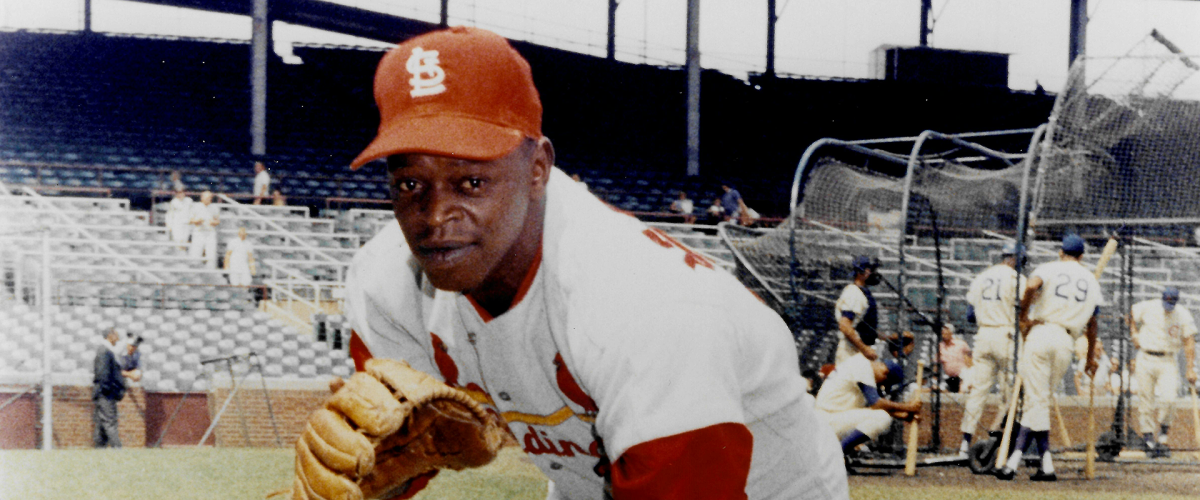
Alvin Neill Jackson was the youngest of 13 children, born on December 26, 1935 in Waco. The family lived near Oakwood Cemetery on South Ninth Street, in an area known then as the “Butcher Pen.” His father worked two, sometimes three, jobs to provide for his family.
According to longtime Wacoan Anthony Fulbright, 77, Jackson began pitching and learned his baseball skills, along with many other African American young people, in leagues organized by Miss Tipton in South Waco.
A.J. Moore High School was a dominant force in the segregated sports in the 1940s and ‘50s and Jackson was a star running back in football and a pitcher in baseball. Under legendary coaches L.H. Ritchertson (football) and Vernon Hicks (baseball), Jackson won all-state honors and A.J. Moore won state football titles in 1951 and ’52, and finished as state runner-up his senior year in 1954.
Jackson accomplished all of this even as he negotiated the brutal racial codes in pre-Civil Rights Waco.
“We lived in a small world,” he told Steve Jacobson, “a separate world. We did have a Black community we could kind of dwell in. You knew when you were crossing the tracks and where you stayed. You didn’t go to white restaurants, because I tried that and it didn’t work.”
Fulbright said that Jackson was “very religious” and was an active member of Antioch Missionary Baptist Church. Years later, after he had excelled in major league baseball, Fulbright said that Jackson returned and made a “significant, sizable” donation to Antioch when the church was building a new sanctuary.
After high school, at the urging Ritchertson and Hicks, Fulbright said that Jackson enrolled in tiny Wiley College in Marshall, Texas, and played baseball. Despite his small size (he was generously listed as 5’10”, 160 pounds), Al possessed excellent control for a left-handed, with a sharp-breaking curveball. By age 20 he signed a contract with the Pittsburgh Pirates organization. After a couple of minor league stops, Jackson was with the Pirates, though he was still in the minors when the Pirates beat the Yankees in an epic seven-game World Series in 1960.
In major league baseball’s expansion draft of 1961 for the ’62 season, National League owners made it difficult for the Houston Colt .45s (later Astros) and Mets to acquire proven players. As a result, the Mets paid for the privilege of drafting ballplayers left unprotected by other teams, including catcher Choo-Choo Coleman, the legendary Gil Hodges (at the end of his career), and Don Zimmer, as well as Jackson, who had been left unprotected by the pitching-rich Pirates.
But America in 1962 was still in the throes of deep-rooted racial prejudice. According to Marty Appel, before the Mets’ first spring training at the Colonial Inn in St. Petersburg, Florida, when a cab brought Jackson to the hotel from the airport, the cabbie said that he would have to take Jackson to the back entrance. Al replied, “I’m not paying you if you do that.” In his room, Al then received a call from the Inn’s manager saying that he could not use either the pool or the dining room. In response, the Mets’ legendary manager Casey Stengel angrily threatened to move the team to another hotel. The Inn’s management relented.
Stengel told writer Leonard Shecter during the Mets’ inaugural spring training that Jackson was one of his best athletes. “He’s got a chance because how many pitchers have I got? He’s very intelligent and his wife’s a schoolteacher. He looks like he’s been pitching baseball for 10 years.”
But the hastily assembled Mets were bad, historically bad, finishing last in every statistical category — pitching, hitting and fielding.
It didn’t matter. Their loyal fans turned out in droves in the old, decrepit Polo Grounds, reveling in their team’s ineptitude. Banners proclaiming “What Me Worry? I’m a Mets Fan” and “Good Grief, Mets” quickly began appearing and thus began life-long love affairs with the Mets’ original players — including Jackson.
At season’s end, the Mets finished with a record of 40-120, 60 games out of first place. The starting pitcher’s records reflect the team’s plight: Jackson (8 wins and 20 losses), Craig (10-24), Craig Anderson (3-17), Jay Hook (8-19) and Bob Miller (1-12).
Over the next few years, so bad were the Mets that Jackson’s few wins were usually shutouts, including the team’s first victory in the new Shea Stadium in Queens, when he beat the Pirates 6-0. The game was played in a cold and steady rain. “It was amazin’,” Stengel said at the time, “and the rain poured in through the roof and rained all over my little pitcher, but he won. He’s my greatest living pitcher.”
One of Jackson’s most memorable games was at the end of the 1964 season as the St. Louis Cardinals battled the Philadelphia Phillies for first place. With the Mets, Jackson out-dueled Hall of Famer Bob Gibson 1-0, delaying the Cards’ championship by a day — and nearly breaking my 9-year-old heart in the process.
During his four years with the Mets, Jackson’s demeanor and professionalism earned his teammates’ highest respect. Of Jackson, who lost 73 games in four years with the Mets, Gary Kroll once suggested that if Al had been a starter on even a mediocre team, “he’d win 20 games every year.”
One of his teammates and closest friends, Ed Kranepool, later had this to say about Al’s tenure with the Mets: “You had to be a pretty good pitcher to lose that many games. He was in the games at the end because he did so many things well. He didn’t throw that hard; his curveball was his best pitch. But he was such a nice guy. He really was. You can’t find a negative thing to say about Al Jackson.”
Just before the 1966 season, Al was traded to the St. Louis Cardinals for slugging third baseman Ken Boyer. Jackson won 22 games for the Cards over the next two seasons and suited up — but didn’t appear — in the St. Louis vs. Boston Red Sox World Series in 1967.
He was traded back to the Mets in 1968 and ’69, then traded yet again — this time to the Cincinnati Reds, just before the Amazing Mets World Series of 1969. With the Reds, Jackson worked primarily in relief, sometimes pitching to a promising rookie named Johnny Bench.
After retirement, Jackson’s knowledge of pitching was such that he was quickly hired by the Boston Red Sox as a pitching coach where he was the first Black pitching coach in the major leagues and then by the Baltimore Orioles. From Baltimore, Al became the beloved, longest-serving pitching coach for his Mets at their spring training site of Port St. Lucie, Florida. In 2018, the New York Mets 2018 media guide declared: “No one exemplifies the Mets organization more than Al Jackson.”
Jackson died at age 83 on August 19, 2019, in a Port St. Lucie nursing home. He was survived by his wife Nadine and sons Reggie and Barry. His passing was reported in a long obituary in The New York Times, with the headline, “Al Jackson, Pitching Star of Woeful 1960s Mets, Is Dead at 83.”
On Jackson’s passing, longtime Mets beat reporter Marty Noble wrote: “…as good a man as you could hope to meet in a half-century around the game. By the pitching standards baseball holds so dear, he produced a mostly modest career. But his character, happy demeanor and unsurpassed decency have put him in the pantheon of the exalted and splendid folks who have walked the planet.”